How to Improve Handwriting Legibility: Line Orientation

Many children have a hard time learning how to form letters and numbers. As a school-based occupational therapist, I receive many referrals for this problem. Handwriting is a very complex function that requires many underlying skills. This post will focus on how to help kids learn to print letters with correct line orientation or place letters correctly on the line. Difficulty with line orientation can make handwriting very difficult to read. Check out this post for more information on the importance of handwriting legibility:  Handwriting Legibility: Why Is It So Important?

Several factors can make a child’s writing difficult to read.  

  1. Poorly formed letters
  2. Letters that are squished together or spread too far apart
  3. Words that are squished together or spread too far apart
  4. Poorly organized writing that is all over the page instead of aligned along the margin and lines of ruled paper
  5. Very faint print that is difficult to see due to inadequate pressure
  6. Very dark print that appears messy due to too much pressure

What Does Trouble With Line Orientation Look Like?

Letters may be written on top of the lines or float above and below the lines. Letters may be too big to fit within the lines. Writing may consist of a mix of big and small letters that vary in placement on the lines. Some children may write with no regard for the lines at all. In this case, letters are typically very large and are randomly placed on the paper. In this post, the focus is on line orientation or letter placement. Being able to discern if letters are tall, short, or descending and place them correctly on the lines of ruled paper is an essential component of handwriting legibility. Problems with line orientation can make handwriting very difficult to read.

Why Do Some Kids Have Trouble With Line Orientation?

  1. Lack of fine motor control
  2. Inefficient pencil grasp
  3. Poor eye-hand coordination
  4. Poor visual-motor integration 
  5. Poor visual processing skills
    1. visual closure
    2. visual discrimination
    3. visual scanning
    4. form constancy

How Can You Address Poor Line Orientation?

There are several ways to help kids learn how to place letters on the line correctly. Here are some things you can do:

Activities

  • Draw lines on a piece of paper. Place the paper in a page protector. Have the child try to form letters and place them correctly on the line using play dough, Wikki Sticks, dry-erase markers, or theraputty. 
  • Roleplay. Allow the child to act as the therapist or teacher. Illustrate errors with line orientation by writing a word or sentence containing a few mistakes. Have the child try to identify and fix the errors. Kids love this!

Use Checklists

Checklists help kids organize and plan the steps needed to edit their handwriting. Some provide a visual model to help kids learn how to identify their errors. Also, checklists are interactive, providing a hands-on approach to the editing process. Who doesn’t like to check off boxes? It can be very satisfying.

Use checklists at the student’s pace. Handwriting checklists often try to tackle too many components at once. This can overwhelm students because it’s too much information to process. I recommend gradually building children’s legibility skills and increasing the challenge as they progress. Determine what deficit is impacting their legibility the most and start there.


The checklists below address only one legibility component, letter placement in progressive steps. The amount of visual cues is faded to match the child’s needs as they improve.

Letter Placement Checklist Level One

I like to laminate checklists or put them in page protectors so they can be used repeatedly with a dry-erase marker. It is helpful for some kids to have the checklist adhered to their desks. You can shrink the image and tape it to the corner of the desk or place it in plain sight. This will serve as a visual reminder to edit their handwriting

Would you like to use these checklists with your little ones? Get your free PDF here:

Change the Paper

If the child is in kindergarten or first grade, make sure they use primary paper. Children this age need the visual structure this type of paper provides. Sometimes children are given wide-ruled paper too soon, and this can be the cause of the problem. In addition to the visual guidelines the primary paper provides, some kids need additional sensory input. There are many forms of modified paper that offer sensory input. Providing paper with color contrast and visuals assists children with learning how to orient letters on the line and letter placement skills. For example, the Smart Start paper featured below has a top blue line with a picture of the sun and clouds. This helps children place tall letters like t, l, and f. The baseline is green, with a picture of a flower that represents grass. This helps children to learn that all letters need to be grounded on the baseline. Provide even more support by providing auditory cues like “tall letters start on the blue sky .”Some children need tactile input. Providing paper that offers raised lines allows kids to see and feel where letters should be placed on the line.

Therapist Choice: Here are some of my favorite writing paper options available at Amazon.

Grades K-1 (Larger lines) Writing Paper
Grades 2-3 (smaller lines) Writing Paper

Disclosure:  As an Amazon Associate I earn from qualifying purchases.

These are just a few of the many types of adapted paper on the market to help kids with letter placement and written organization skills.


To further reinforce line orientation skills, you can have the child scan written material (their handwriting or any text). Ask them to draw a circle around or highlight a particular category of letters. For example, highlight the tall letters, or draw a circle around the “diver” letters. This will improve awareness of variations in letter size. It will also help with visual scanning skills.

Want to learn more on this topic? Check out these posts from my Handwriting Series:

How To Improve Handwriting Legibility: Pressure Grading (how-much-force-to-apply)

How To Improve Handwriting Legibility: Spacing

As always, have fun!

Disclaimer: 

The Fun Strokes blog is designed for educational and informational use only for teachers, therapists, and parents. It is not intended as medical advice or therapeutic treatment that would be provided in an individualized treatment plan. If you suspect a child has delays, please consult an occupational therapist.

How To Teach Grade-Schoolers Organizational Skills…Starting With the Disorganized Desk

Having a disorganized desk can make school hard to manage.  When the teacher asks his or her students to take out their science books and turn to page 57, the child who is lost in their desk trying to find the book often can not remember the page number once it is found. Many times this student will remain lost in the lesson because of their fraught start.  Tasks that should be simple become overwhelming and time- consuming often leading to stress and frustration.  Organization can be an elusive skill that many kids struggle to acquire.  The fact of the matter is there’s a lot that goes into being organized.  Organization is part of a set of skills called executive functions.  Keeping a desk organized requires more than just putting things away.  Managing school materials requires planning, prioritizing, decision making, sequencing, task initiation, and following through with those tasks to completion.  Some kids need extra help to set up and maintain an organized desk space at school.  This post will focus on how to provide grade-schoolers with the support they need to establish and sustain a functional workspace at school.

Use Visuals

Visuals paint a picture of exactly what is expected of the child. Often kids just don’t know what teachers mean when they say, “clean your desk”. Providing kids with a visual helps them to wrap their heads around what they are supposed to do when challenging requests are made.

How to Fix...The Disorganized Desk: Create a Desk Map

Create a desk map by organizing the contents of the desk and then taking a picture of your expectation. Designate time to work on organizing the desk. How often you do this will depend on the student’s needs. Some will need to do this every couple of days, other students may just need it once a week. Over time, you should expect the amount of time and support needed to decrease and the student develops the skills needed to stay organized.

Teach students how to decide whether to trash items or keep them. Old graded papers should go home for parents to see. Create a location (folder/envelope) for these papers to go. Important papers like class notes and worksheets need to be placed in a binder or glued into a notebook, whatever system is in place.

Throw away old crumbled papers, wrappers, leftover snacks, crayon paper shavings, eraser bits, and whatever else can be disposed of. This makes it easier to keep the desk neat and organized.

Place homework in a folder designated as such. Label the compartments, for example, “keep at home” and “bring to school” or “to do” and “completed”.

Create Divisions

Divisions assist the student with knowing where to place items. For example, place books on one side, notebooks/folders on the other, pencil box, pouch, and other compartments on top.

Use Checklists

Checklists help children with breaking down the steps of a task. In this case, checklists tell the child exactly what should go in each division of the desk.

How to Fix...The Disorganized Desk: Make a Checklist for Each Division

Checklists are also interactive and hands-on. Children check the boxes as the task is being completed. This ensures the completion of each step, as the boxes are checked as one moves down the list. This is very helpful for students who need assistance with sequencing the steps to a task or get lost trying to figure out where to start. It also provides immediate positive reinforcement that progress is being made with a nice visual to display it. I love to scratch items off my to-do-list! It makes me feel very productive and accomplished. Whether it be my chore list, my grocery list, or my Christmas gift list, the feeling is always the same and it is always good. Children need to feel accomplished as well, and checklists are a great visual motivator.

How to Fix...The Disorganized Desk: Laminate For Durability and Dry Erase Marker Use

Lamination makes it possible to use the desk organization system as many times as needed without worrying about making copies. I also recommend using thick paper, like the index cards in the picture above. The end result is a durable tool that should last several months.

How to Fix...The Disorganized Desk: Add a Key Ring

I like to create a flippable booklet by placing a hole in the corner using a paper hole punch. Then use a key ring to secure the pages. I love those little adhesive plastic hooks that can be purchased almost anywhere. Attach the hook to the side of the desk and hang the booklet there.

If you are concerned that it will get lost, you can also tape the cards to the desktop.

How to Fix...The Disorganized Desk: Hang or Place Desk Booklet on Desk

Build Independence

Teach your student how to use the booklet. Gradually pull away and let the student follow the steps on their own. Perform desk checks weekly or as often as needed to reinforce how to use the organization system correctly. Eventually, the level of assistance will decrease and your student will become more independent with keeping the contents of their desk organized.

Happy Organizing! I hope you will find this post helpful. Please comment if this system has worked for you and your students or if you have a strategy of your own that you’d like to share.

Disclaimer: 

The Fun Strokes blog is designed for educational and informational use only for teachers, therapists, and parents. It is not intended as medical advice or therapeutic treatment that would be provided in an individualized treatment plan. If you suspect a child has delays, please consult an occupational therapist.

The Frugal OT Series…Reading Highlighters

Dollar Tree Find of the Month

Introducing my February Find of the Month: Reading Highlighters or as I like to call them…visual scanning aides.

For just one dollar you get 10 of this wonderful tool that helps with so many things.  These strips come in two different color transparencies, yellow and blue, and lots of cute borders options that the child can choose from. 

The Frugal OT Dollar Tree Pick of the Month:  Reading Highlighters
Reading Highlighters from Dollar Tree

Let me count the ways these reading strips can benefit a child…

  1. Helps children who have difficulty with visual tracking (eye movement that enables the eyes to aim their focus on the line without losing place). 
  2. Helps to prevent skipping words, sentences, and lines altogether.
  3. Helps to increase focus/concentration by providing more visual input; this is good for children who have difficulty attending to visual information on a page or are overwhelmed by too much visual information presented on a page.
  4. Provides tactile input for children who need to have something in their hand or need to touch something.
  5. Increases the level of engagement in the reading task as the child must move the reading strip along the lines of text as they read.
  6. Serves as a bookmark which is a great reminder for kiddos to use their reading strip consistently.

How to Use Reading Highlighters:

Using these strips is very simple. Simply place the transparent portion of the strip over the line of text that is being read; much like using your finger to keep place along a line of text. Move the reading highlighter over each line of text as it is being read.

So if you know a child who has needs fitting any or all of the descriptions above, try these visual tracking aides! Leave a comment if this tool has helped your little one, or share successful tips you like to use.

Disclaimer: 

The Fun Strokes blog is designed for educational and informational use only for teachers, therapists, and parents. It is not intended as medical advice or therapeutic treatment that would be provided in an individualized treatment plan. If you suspect a child has delays, please consult an occupational therapist.

9 Strategies to Increase Attention and On-Task Behavior

Above all, the most important thing needed for a child to progress with anything is focus. When presenting a child with a task, particularly a novel task, you must establish meaningful engagement with the child, in other words, where the child can focus on the task. What exactly does focus mean? The ability to sustain selective attention or concentration on the task at hand while ignoring or filtering out the non-relevant or distracting information in one’s environment. Sustained selective attention yields steady results on a task over time. For some children, often, this is very challenging.

ADHD, autism, executive function disorder, and learning disabilities are only some of the conditions that may cause children to have trouble focusing, especially when presented with a non-preferred activity. When working with children that have difficulty concentrating, you need to start where they are and build from there. Do not try to push a child beyond their threshold, as you will likely not get the results you seek. Instead, gradually work their way up to lengthier engagement periods and greater attention spans.

Here are some guidelines, attention span in typically developing children is about 3 to 5 minutes per year of age. For example, if a child is four years old, you can expect that they will attend to an educational task like letter recognition for about 12 to 20 minutes. Attention span is typically greater for preferred activities like playing a video game, watching a video on an iPad, or wherever the child’s interest lies. Attention span may be less for an activity that is extremely difficult or frustrating for the child. During those times, providing a customized level of challenge and other support is crucial to spark greater focus.

How To Build Attention Span:

Figure out their baseline and build from there.
Determine Their Baseline
  1.  Figure out their baseline and build from there: Assign a task, use a timer, and determine how long the child can remain on task. Do this a few times and take an average. For example, if the child can work on learning to write letters for only 2 minutes, then set their challenge for 4 minutes and offer support (described below) to get them there. Once they’ve reached 4 minutes, shoot for 6 minutes. Continue to build on what they can already do. It is helpful to let the child know how much time is remaining, for example, saying, “one more minute and then all done.”
Get To Know Your Learner
  1. Get to Know Your Learner:  Some kids are visual learners, some are auditory, and some are hands-on learners. Provide the type of input the child needs. For example, let’s say the child is learning to form letters. For a hands-on learner, provide lots of tactile input. Use a cookie sheet to make letters in whipped cream or pudding. For the visual learner, add food coloring to the whipped cream to create a more intense visual experience. For the auditory learner, sing verbal prompts to the tune of a popular kid’s song. For the multi-sensory learner, do all of the above. Cater to their learning style. 
Provide Movement Opportunities
  1. Provide Movement Opportunities:  Research has shown that when students engage in physical activity and movement breaks throughout the school day, learning, behavior, and social improvements are seen. But don’t stop there. Offer movement opportunities during the task as well. Place a wiggle cushion on the child’s chair (DIY option, use a deflated beach ball), or have them sit on an exercise ball instead of a chair. Some children respond well to hand fidgets; having something to manipulate in their hand can help with focus. Some children may prefer to stand rather than sit. Why not? Sitting still is not your goal; on-task behavior is!

Therapist’s Choice: Allow for movement during the task using one of these options. Here are my top picks for flexible seating available at Amazon.

Disclosure:  As an Amazon Associate I earn from qualifying purchases.

Provide Environmental Supports
  1. Provide Environmental Support: Limit visual and auditory distractions. Provide a workspace that is free of clutter. It is important to consider wall space as well. Many wall pictures/posters and other things can be visually overstimulating. Provide an organized workspace that promotes calm and, ultimately, concentration. Some children struggle to tune out ambient noises, and noise-canceling headphones can help. Some children respond well to calming music. Mindfulness playlists and other playlists geared to improve focus are available on YouTube.

Therapist’s Choice: The noise-canceling headphones in the links below are my top picks. Both are available at Amazon.

Disclosure: As an Amazon Associate I earn from qualifying purchases.

Break down big tasks into smaller tasks
  1. Break down big tasks into smaller ones:  Modify assignments to avoid overwhelming the child. For example: if doing a math worksheet with 20 questions, have the child complete only the odd or even-numbered items. Most often, children only need to solve some problems on a worksheet to demonstrate an understanding of the material. Strive for quality rather than quantity.
Create a Checklist
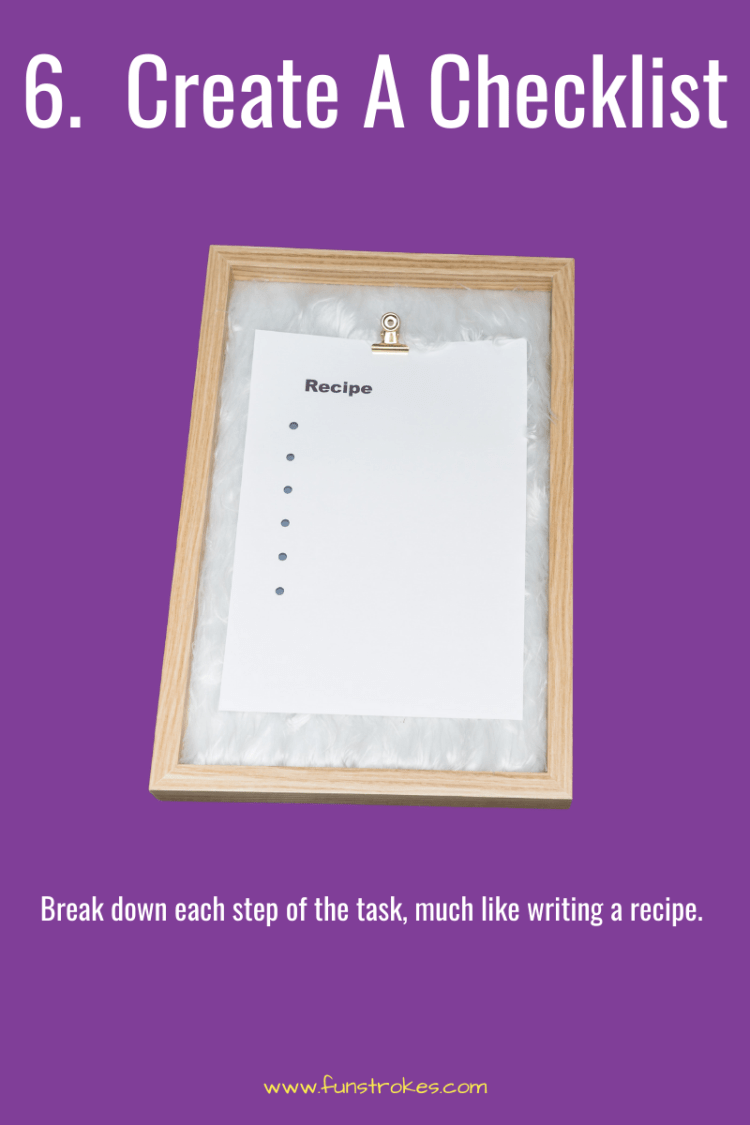
  1. Create a Checklist: Support executive functioning skills by creating a checklist. Checklists help the child understand how to approach a task. Indicate what to do first, next, and so on. Break down each step of the task, much like writing a recipe. Have the child check the boxes as they work. Not only will this help with planning and organization, but it also offers a sense of accomplishment that will serve as positive reinforcement.   
Use a Timer
  1. Use a timer: Timers facilitate time management skills. They will help the child understand your expectations for the work span. There are many types of timers designed to meet the specific needs of children. For example, some children do not respond well to auditory timers because the chime can cause anxiety. In this case, visual timers are a great option. Instead of a chime, the visual marker gradually disappears as time elapses.  

Therapist’s Choice: The visual timers in the links below are my top picks. The one on the left is portable, only 3 inches tall, and ideal for use on a desktop. The one on the right is available in two sizes, 8 and 12 inches. Suitable for use by teachers in the classroom setting. Both are available at Amazon.

Disclosure: As an Amazon Associate I earn from qualifying purchases.

Offer Rewards
  1. Offer Rewards: We all work better when our efforts are recognized and rewarded. Determine what motivates the child and offer whatever that is as a reward. For example, some kids like edibles, while others may enjoy screen time. Reward/sticker charts are helpful as the child can see what they are working for and how close they are to getting it. Take advantage of every opportunity to celebrate. Recognize every accomplishment, big and small. For example, the child remained focused for an increased amount of time (even if the work is not finished, recognize the effort and time spent on the task).
Provide Breaks
  1. Provide Breaks: This strategy may be the most important! Once the child has reached their maximum level of meaningful engagement in the task, take a break! If this means offering a break after only a few minutes on task, do it. You may feel like the child is not as productive as you’d like them to be, but you will find the opposite in the end. Breaks allow the child to hit the reset button, returning to work demands with renewed focus and energy. By following the suggestions above, you will gradually see an increase in attention span. As attention span develops, the frequency of breaks needed will decrease. Stick with it, and all the hard work will pay off.   

Fun Strokes Freebie!

Here’s a snapshot of the 9 strategies to increase attention and on-task behavior discussed in this post. Use it as a quick reference when working with your child or student.

9 Strategies to Increase Attending Skills

Do you know someone who may benefit from the information in this post? Please share using the link below!

Disclaimer: 

The Fun Strokes blog is designed for educational and informational use only for teachers, therapists, and parents. It is not intended as medical advice or therapeutic treatment that would be provided in an individualized treatment plan. If you suspect a child has delays, please consult an occupational therapist.

The Frugal OT Series: Little Laundry Line

Introducing…”The Frugal OT” Series featuring my Dollar Tree Find of the Month

I love to have fun with the kids that I work with by introducing new activities that they will enjoy.  But I don’t like to break the bank in doing so.  I love to save money whenever I can.  Who doesn’t?  One of my favorite places to shop for therapy supplies is Dollar Tree.  With a little imagination, this store provides an endless supply of materials that can be used in your therapy room, classroom, or home.  Welcome to the Frugal OT Series where I will showcase Dollar Tree finds and show you how to transform them into wonderful fine motor activities targeting various skills. 

January’s Activity of the Month:  Little Laundry Line

The Frugal OT Series Dollar Tree Pick of the Month:  Little Laundry Line

Dollar Tree Shopping List:

  • mini clothespins
  • felt
  • yarn

Additional materials needed:  scissors, markers, glue, cardboard box

Optional:

Background paper of choice (I printed an image of the sky and taped it to the box as a backdrop.)

Draw images of clothing freehand or use paper doll clothing templates (I googled paper doll clothing templates and printed them. I then traced the images onto the fabric and cut them out.)

Watch video: Pretend Play “Little Laundry Line”

Little Laundry Line

Music Credit: Sunshine Day by Mixaund | https://mixaund.bandcamp.com

Skills Addressed:  Shoulder strength, fine mtor strength, grasping skills, bilateral coordination, motor planning

Grade Up (increase level of difficulty): 

Translation: Have child place several clothespins in their hand to work on palm to finger translation

Visual Sequential Memory: Have the child try to remember the sequence of clothing placed on the line and duplicate it on the other side

Core Strength: work core muscles by having the child complete this activity while lying on tummy

Grade Down (decrease level of difficulty):  Take clothes off instead of on, place on lap versus tabletop

This activity would be great as a choice in your fine motor center, pretend play center, or as a stand-alone. This would also be very cute as an accessory to a dollhouse or play with dolls in general. You can substitute doll clothes in place of the felt clothing. I hope you and your little ones will enjoy this activity! Stay tuned for next month’s Dollar Tree pick!

Disclaimer: 

The Fun Strokes blog is designed for educational and informational use only for teachers, therapists, and parents. It is not intended as medical advice or therapeutic treatment that would be provided in an individualized treatment plan. If you suspect a child has delays, please consult an occupational therapist.

A Quick and Easy Way to Improve Pencil Grasp

Please don’t trash  those little broken crayons!  

Many people are led to believe that preschoolers should use those big fat jumbo crayons that you see advertised.   Quite the contrary.  Short crayons, that are the standard width are your go-to.  Why? These little gems, which are often discarded, offer so many benefits.  Let me explain how.

A tripod or quadrupod grasp is expected by age 3-4.

When using such a short crayon it’s pretty hard to fit all 5 fingers around it.   So for those kiddos who have not transitioned from using a fisted or immature grasp to a more skilled tripod or quadrupod grasp, this is one of the best and easiest ways to correct it.  

Standard crayons are much easier to grasp than those big jumbo crayons.  When you think about it, little hands need little writing utensils because they offer better handle and control.

So keep a crayon box full of broken crayons and use them often!


Disclaimer: 

The Fun Strokes blog is designed for educational and informational use only for teachers, therapists, and parents. It is not intended as medical advice or therapeutic treatment that would be provided in an individualized treatment plan. If you suspect a child has delays, please consult an occupational therapist.

Pencil Grasp Development: What to Expect

As a child grows and develops, how he or she holds a writing utensil also develops. Written output starts with scribbling and eventually becomes precise letters, numbers, and illustrations. Here is what you can expect to see as a child’s grasp evolves.

Fisted Grasp 1-1.5 years old

Fisted Grasp:

1 -1.5 years Old

When a child begins to hold a writing utensil to make scribbles this is the typical grasp pattern that is used. The utensil is held with a closed fist; movement originates in the arm and the whole hand moves the utensil.

Pencil Grasp Development
Digital Pronate Ages 2 - 3
Static Tripod Ages 3.5 - 4
Static Quadrupod Ages 3.5 - 4
Static Pencil Grasp Patterns

Digital pronate 

Ages 2-3

Fingers are pointed toward paper. 

Static tripod 

Ages 3.5-4

Fingers don’t move; the pencil is mostly controlled by arm movement. Three fingers are used to hold the writing tool. The pads of the thumb and index fingers pinch while the utensil rests on the side of the middle finger. 

Static quadrupod 

Ages 3.5-4

Fingers don’t move; the pencil is mostly controlled by arm movement. This grip differs from the static tripod in that four fingers are used to hold the writing tool. The pads of the thumb, index and middle fingers pinch while the utensil rests on the side of the ring finger. 

Pencil Grasp Development
Dynamic Tripod:  Ages 4.5 - 6
Dynamic Quadrupod Ages 4.5 - 6
Lateral Tripod Ages 4.5 -6
Lateral Quadrupod Ages 4.5 - 6
Dynamic Pencil Grasp Patterns

There are four grasp patterns that research has found to be mature and appropriate for functional writing. The difference between these grasps and the static grasps described above is that the fingers are moving and controlling the output of the writing tool.

Dynamic tripod 

Ages 4.5-6

The dynamic tripod is the most commonly recommended grasp for handwriting although the three others shown are also suitable. Three fingers are used to hold the writing tool. The pads of the thumb and index fingers pinch while the tool rests on the side of the middle finger. Movement is generated by the thumb, index, and middle fingers. 

Dynamic quadrupod 

Ages 4.5-6

Four fingers are used to hold the writing tool. The pads of the thumb, index and middle fingers pinch while the tool rests on the side of the ring finger. Movement is generated by the thumb, index, middle, and ring fingers. 

Lateral tripod 

Ages 4.5-6

Three fingers are used to hold the writing tool. The thumb is held against the side of the index finger and crosses over the top of the writing utensil. Movement is generated by the index and middle fingers. There are four grasp patterns that research has found to be mature and appropriate for functional writing. The difference between these grasps and static grasps is that the fingers are moving and controlling the output of the writing tool. 

Disclaimer: 

The Fun Strokes blog is designed for educational and informational use only for teachers, therapists, and parents. It is not intended as medical advice or therapeutic treatment that would be provided in an individualized treatment plan. If you suspect a child has delays, please consult an occupational therapist.

Benefits of Working on a Vertical Surface

There are many reasons to use a vertical surface like an easel or whiteboard when working with children. Children attain so much more by simply changing tabletop activities to vertical surface activities. Here are the many benefits the child will gain:

  • Develops strength and stability in the joints and muscles of the arm
  • Encourages correct wrist position, which facilitates hand stabilization and correct pencil grasp
  • Builds eye-hand coordination
  • Builds core strength by engaging the muscles that connect our upper and lower body, which supports a good upright posture
  • Provides sensory input by allowing for movement and the ability to change position while standing or kneeling to work
  • Develops spatial awareness as directional terms like up, down, and across are easier to understand when they are in relation to our own body
  • Encourages visual attention because the child is working at eye level, which can be very helpful for children who struggle with looking at what they are doing
Benefits of Working On A Vertical Surface

What You Can Do:

  • Draw, color, paint on an easel versus tabletop whenever possible
  • Tape coloring sheets/worksheets to wall/window
  • Pushpin art: place a coloring sheet on a cardboard surface taped to the wall and trace the outline of the image using a push pin with adult supervision
  • Be creative with finger painting on an easel or whiteboard by using shaving cream and food coloring
  • Draw on a window or mirror using dry erase markers
  • Bath art using tub crayons
  • Place stickers on paper adhered to wall and play connect-the-stickers
  • Use the Fun Strokes Pre-Writing Program
Fun Strokes is an innovative pre-writing program that is taught on a vertical surface.

Get Your Free Infographic Here:

So whenever the opportunity presents itself, build your child’s fine motor skills by working on a vertical surface!

Disclaimer:

The Fun Strokes blog is designed for educational and informational use only for teachers, therapists, and parents. It is not intended as medical advice or therapeutic treatment that would be provided in an individualized treatment plan. If you suspect a child has delays, please consult an occupational therapist.

What Are Fine Motor Skills?

Fine Motor Skills Unveiled 

You won’t believe all that goes into fine motor skill development.  Unless you are a pediatric occupational therapist like me or work in the medical or educational field, you’ve probably never even thought about it.  But when you have precious little ones in your life, it’s a pretty good idea to know what to expect as they grow and navigate their world.  Find comfort in knowing if they are on track or maybe need a little help getting there. 

While reading this blog I hope that you learn all about fine motor development and how to help your child meet these essential milestones in a fun and engaging way.  Let’s take a minute to talk about fine motor skills and what this actually means.  Most people think of all the little muscles in our hands and fingers, and developing those muscles to be able to perform tasks like fastening buttons, stringing beads, cutting with scissors, and handwriting. What most people do not realize is all that is necessary for fine motor skills to develop.  In this post, I will provide a brief description of each skill component. Gee, where do I start as so many things go into this most important and complex skill!   

Let’s begin at the root of everything, our core.  You know, all the muscles in the middle of our bodies, our tummy and back.  This is our foundation, where all movement originates.  If our core is not strong and steady, it is nearly impossible to do anything coordinated and skilled with our legs, feet, arms, and hands.  Just imagine building a house without a solid foundation.  Your structure will not be very sound. Our core is also the tripod for our eyes. The platform on which we take the photo of our environment. A steady base takes a clear shot! Skill acquisition starts here! 

Now I’ve only scratched the surface, there is still so much more to talk about.  From here I’ll move on to shoulder stability. The shoulder girdle is the anatomical structure that houses the arm.  The muscles supporting this joint must be strong and brawny to enable the arms and hands to carry out precise movements. And since I’m on the subject of arms, let’s talk about how they must work together. Or, in other words, the importance of bilateral coordination.  Many tasks require the operations of two hands working in a concerted manner.  Cutting food, opening containers, tying shoes, stabilizing paper while writing, …just to name a few!  

Okay, next I’ll talk about eye-hand coordination.  This is another important team of body parts that need to work together.  The body must coordinate controlled hand movement with controlled eye movement.  The brain must process the visual information that it receives to guide the movement of the arm and hand to execute a function.  And of course, the eyes need to be able to make sense of what it sees, also known as visual perception.  This is the ability of the eyes to send visual information to the brain. The brain then processes and interprets the visual information.  Okay, at this point you might be thinking….  are we there yet?

Nope, stay with me! Believe it or not, there’s still more to talk about.  Fine motor skill development requires visual-motor integration skills as well.  This is the ability to perceive and process visual information to deliver a motor response. Being able to copy shapes and form letters requires visual-motor integration.

Then we have proprioception and sensory processing skills.  Now that’s a mouthful.  What is that? You may be wondering.  Proprioception is the ability of our body to know how it is moving and where it is in space. For example, being able to close your eyes and touch your nose with the tip of your index finger. Sensory processing skills are the ability of our body to receive and interpret sensory information and deliver an appropriate response to the sensory information.    

Stay with me, we are almost there! 

Hand strength is also very important.  Strength in the hands allows us to apply adequate force to push or pull objects, to grip and hold objects, and to carry things. Adequate hand strength is necessary for pencil grip and many other fine motor tasks.

Finally, I will get to the last skill component, motor planning.  This is often referred to as praxis. Motor planning is the ability to know what steps to take, in what order, and then carry out the novel motor action needed to execute the plan.

Wow, can you believe how much goes into fine motor skill development? Applaud the little people in your life as they tackle this very complex skill. If a child is struggling with fine motor skill development, it may be due to one or more of the many things discussed in this blog.  Seek the advice of a pediatric occupational therapist if you have concerns.  

Would you like to have this info at a glance? This infographic does just that:

Fine Motor Skills Unveiled
Disclaimer: 

The Fun Strokes blog is designed for educational and informational use only for teachers, therapists, and parents. It is not intended as medical advice or therapeutic treatment that would be provided in an individualized treatment plan. If you suspect a child has delays, please consult an occupational therapist.

Book Launch…Fun Strokes!

It is with great enthusiasm that I introduce the world to my new book, Fun Strokes. My name is Linda Craig Dennis and I am a pediatric occupational therapist. One of the most frequent referrals we receive as occupational therapists working with children is handwriting referrals. Kids who, for many different reasons, have difficulty learning the complex skill of handwriting. When working with these kiddos I learned that many are unable to draw simple shapes. If children are unable to draw simple shapes, then you can forget about teaching them how to write letters. Simple fix right? Just teach them how to do it. But there was a problem. You see, it turned out that most of the kids I’ve worked with had no interest in drawing basic shapes. Sure, they’d engage in multi-sensory experiences like playing and drawing shapes in shaving cream, finger paints and, play dough. But as soon as I handed the child a writing utensil, the interest in the activity was lost. It seemed as though everything I tried did little or nothing to spark interest. We all know that for most kids if there is no interest there is no attention to the task. If children aren’t motivated to pay attention, very little progress is to be made.

One day, I had a clever idea. Why not use magnets, colorful and fun magnets that can be used on vertical surfaces. This way the child is working at eye level and visual attention is captured. Not to mention the abundance of other skills working on a vertical surface provides. I went to work creating these magnets, hoping that my clients would be intrigued by the hands-on, interactive, and vibrant shapes placed in front of them. When I implemented the pre-writing magnets into my practice, I knew instantly that they were a hit. Even my toughest kiddos who had very short attention spans, would stand at the easel, place the magnets on the easel and use their marker to draw the missing pre-writing strokes. They loved wiping the surface clean and doing it again and again.

This has inspired me to make the Fun Strokes pre-writing program available for all kiddos, especially those who struggle with learning how to write. All kids benefit from being prepared for school. There are so many challenges to school success, let’s not let handwriting be one of them. What good is a house without a strong foundation? Before little ones enter kindergarten, give them the strong foundation they need for handwriting success, the Fun Strokes pre-writing program!